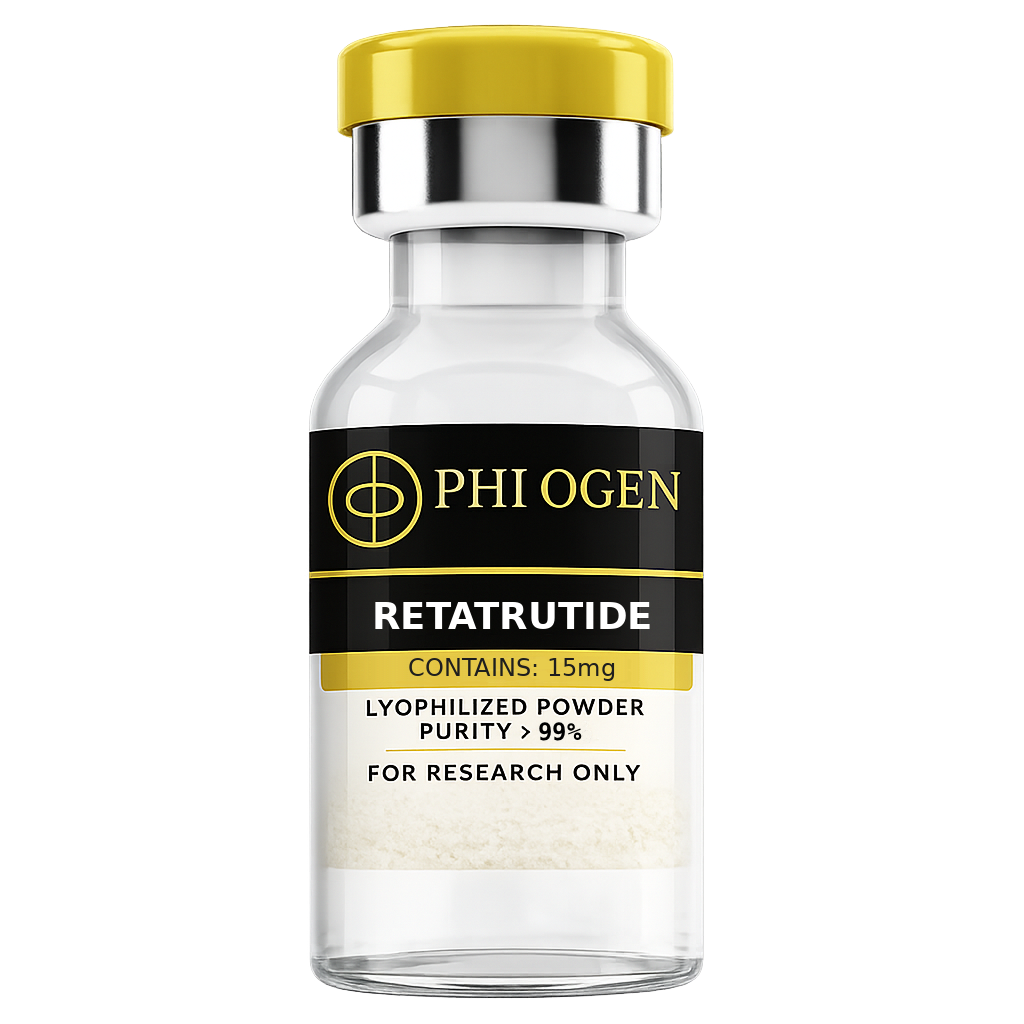
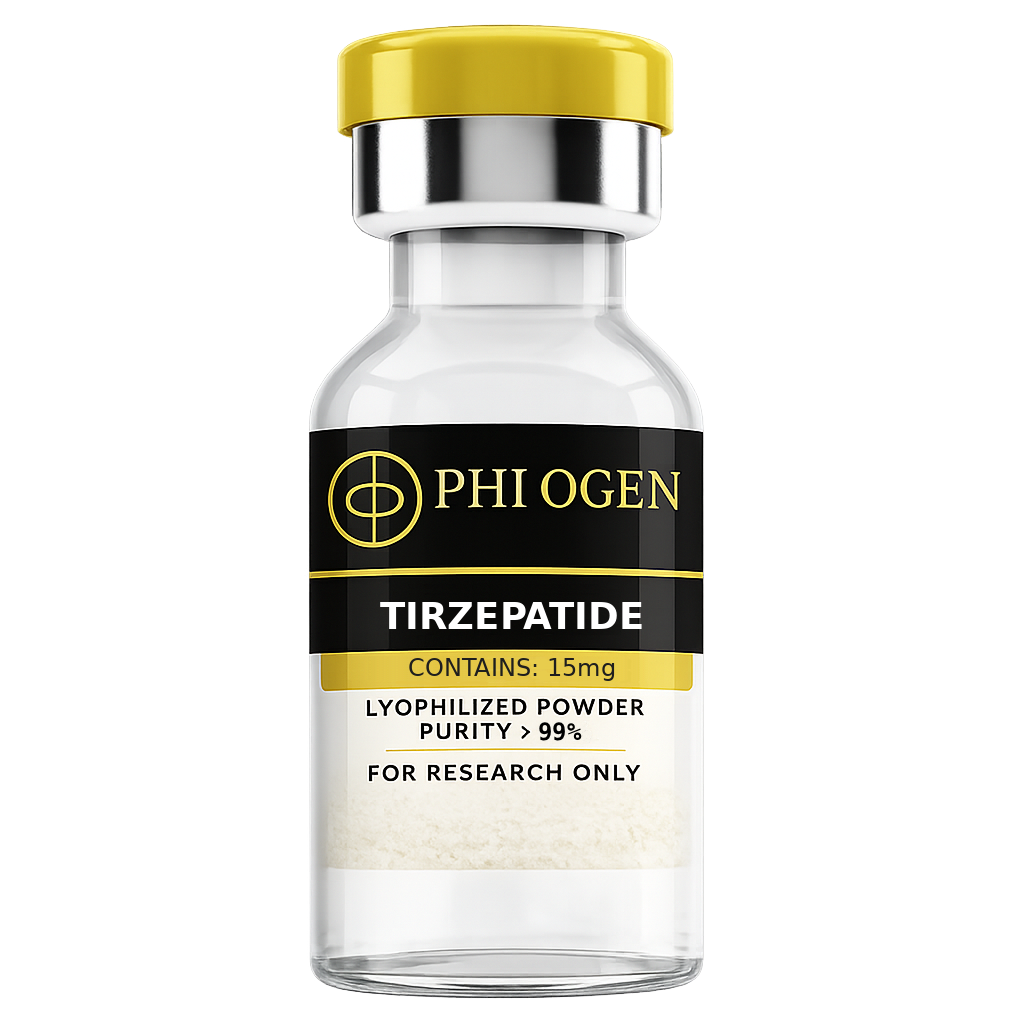
Trial Data at a Glance
The two most closely watched incretin-based compounds in active research differ by one receptor and by roughly 8 percentage points of body weight reduction in their best available trial data.
Retatrutide (Eli Lilly, Phase 2, NCT05394519): 8 mg/week subcutaneous, 48 weeks — mean body weight reduction of −28.7%. Notably, the dose-response curve had not plateaued at week 48, suggesting continued efficacy beyond the trial window.
Tirzepatide SURMOUNT-1 (NCT04184622, Phase 3): 15 mg/week subcutaneous, 72 weeks — mean body weight reduction of −20.9% (highest dose cohort). Secondary endpoints included significant improvements in waist circumference, blood pressure, and fasting glucose.
Receptor Architecture: Why the Third Target Matters
Tirzepatide: GLP-1R + GIPR
Tirzepatide is a unimolecular dual agonist developed using a fatty-acid conjugation strategy that gives it differential affinity across both receptors. GLP-1R activation drives hypothalamic satiety signalling and delays gastric emptying. GIPR agonism in adipose tissue enhances insulin-stimulated lipid uptake and promotes insulin sensitisation independently of the GLP-1 pathway.
The combination explains SURMOUNT-1's superiority over semaglutide STEP trials (−14.9% at 68 weeks), but the fat loss mechanism is still predominantly appetite-driven and mediated through caloric restriction.
Retatrutide: GLP-1R + GIPR + GcgR
Retatrutide adds the glucagon receptor (GcgR) — and this is mechanistically significant. Glucagon receptor engagement drives:
- Hepatic beta-oxidation: Direct activation of fatty acid oxidation pathways in the liver, independent of caloric intake
- Brown adipose thermogenesis: GcgR stimulation in brown adipose tissue elevates uncoupling protein 1 (UCP1) expression, increasing resting energy expenditure
- Glycogenolysis: Hepatic glycogen mobilisation, reducing substrate availability for lipogenesis
The net result: retatrutide subjects are not only eating less (GLP-1R/GIPR) but also burning more at rest (GcgR). This dual-mechanism approach — simultaneous intake reduction and expenditure increase — is mechanistically distinct from anything achieved by mono- or dual-agonism alone.
Interpreting the Phase Gap
The −28.7% vs −20.9% comparison is not a clean head-to-head. Phase 2 trials are smaller, shorter, and typically show more optimistic results than Phase 3. When compounds move to Phase 3 with larger, more diverse populations and stricter endpoint definitions, effect sizes routinely compress by 15–30%.
Retatrutide's Phase 3 data (NCT05882045, ongoing as of 2026) may produce numbers closer to 22–25%. However, even accounting for Phase 3 regression, the triple agonist mechanism is expected to maintain at least a clinically meaningful advantage over dual agonism based on preclinical pharmacology.
Lipid and Metabolic Secondary Endpoints
| Retatrutide Phase 2 | Tirzepatide SURMOUNT-1 | Body weight reduction | −28.7% | −20.9% |
| Waist circumference | −27.7 cm (highest dose) | −14.1 cm |
| Triglycerides | −42% | −24.5% |
| Fasting glucose | Significant reduction | Significant reduction |
| Trial duration | 48 weeks | 72 weeks |
| Phase | Phase 2 | Phase 3 |