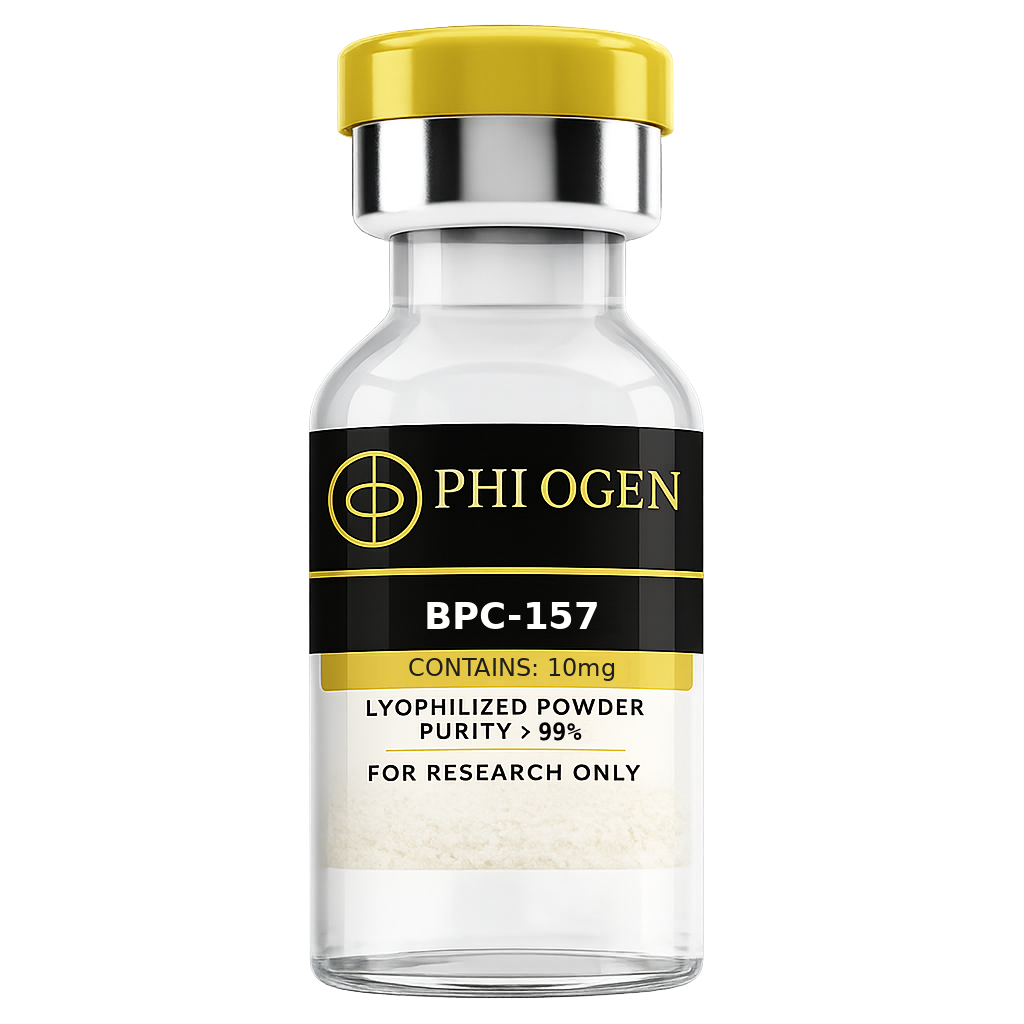
Why Two Healing Peptides?
BPC-157 and TB-500 are frequently co-administered in recovery-focused research protocols, but the rationale is not redundancy — it is mechanistic complementarity. The two compounds operate through distinct pathways, have different pharmacokinetic profiles, and address different aspects of the tissue repair process. Understanding both is necessary to evaluate whether stacking is appropriate for a specific research application.
BPC-157: Local Precision Repair
BPC-157 (Body Protection Compound-157) is a 15-amino-acid synthetic peptide derived from a sequence within human gastric juice protective protein. Its preclinical literature exceeds 140 indexed studies — the largest evidence base of any research peptide.
Primary Mechanisms
VEGFR2 upregulation: BPC-157's most replicated mechanism. Upregulation of vascular endothelial growth factor receptor 2 drives angiogenesis — capillary formation at injury sites. New vascular supply is rate-limiting in the healing of avascular and hypovascular tissues: tendons, cartilage, and the deeper dermal layers. BPC-157's angiogenic drive in these tissues is the mechanistic basis for the tendon healing evidence.
FAK-Paxillin pathway: Focal adhesion kinase (FAK) and paxillin govern cell migration and attachment during tissue remodelling. BPC-157 activation of this pathway promotes organised cell motility — the directed movement of fibroblasts and myoblasts into the wound space.
Nitric oxide synthase upregulation: Increases NO production in the target tissue, maintaining microvascular tone, promoting epithelial barrier integrity, and providing the primary gastroprotective mechanism.
NF-κB suppression: Reduces inflammatory cytokine output (TNF-α, IL-1β, IL-6), allowing the resolution and remodelling phases of tissue repair to proceed without ongoing destructive inflammation.
Evidence Profile
|---|---|---|
Grade A represents multi-lab, multi-model replication. Grade B represents mechanistically plausible findings with primary-group or limited independent replication.
Pharmacokinetics
- Half-life: ~4 hours (subcutaneous administration in rat models)
- Route: Subcutaneous, intramuscular, oral (some evidence for oral bioavailability via enteric absorption)
- Distribution: Concentrates at injury sites — the compound shows affinity for damaged tissue, which is mechanistically consistent with its VEGFR2 and FAK upregulation being most active at sites of elevated growth factor expression
TB-500: Systemic Distribution and G-Actin Sequestering
TB-500 is the research-grade name for a synthetic version of Thymosin Beta-4 (Tβ4) — a naturally occurring 43-amino-acid protein found in virtually all nucleated mammalian cells. TB-500 corresponds to the active sequence fragment (residues 17–23: LKKTETQ) that mediates the G-actin sequestering activity of the parent molecule, though many commercial TB-500 preparations contain the full or near-full Tβ4 sequence.
Primary Mechanism: G-Actin Sequestering
Thymosin Beta-4's defining biochemical property is its high-affinity binding to monomeric G-actin (dissociation constant Kd ~0.7 µM). By sequestering G-actin, Tβ4 indirectly regulates the G-actin/F-actin ratio — the balance between monomeric and polymerised actin that governs cell morphology, migration capacity, and contractility.
In the context of tissue repair:
1. Injury triggers actin cytoskeletal reorganisation in neighbouring cells
2. TB-500 increases available G-actin pool by sequestering monomers
3. This shifts cytoskeletal dynamics in ways that facilitate cell migration into the wound space
4. Migrating cells (fibroblasts, endothelial cells, macrophages) populate the injury site and initiate organised repair
This is a fundamentally different mechanism from BPC-157's receptor-mediated approach — it operates at the cytoskeletal level rather than through growth factor receptor signalling.
Additional TB-500 Mechanisms
Anti-inflammatory: Tβ4 has been shown to downregulate inflammatory mediators including IL-6 and TNF-α, with some evidence for NF-κB pathway involvement — an overlap with BPC-157 at the anti-inflammatory level, though through distinct upstream pathways.
Angiogenesis: Tβ4 promotes endothelial cell migration and tube formation, contributing to angiogenesis independently of VEGF signalling — again complementary to BPC-157's VEGFR2-driven pathway.
Cardiac repair: The most clinically investigated application: Phase 1/2 trials (MAGIC-TA, NCT01311518) in post-myocardial infarction patients showed safety and some signal for reduced infarct size. This is the only human trial data for a Tβ4-related compound.
Pharmacokinetics
- Half-life: Approximately 8–10 days (significantly longer than BPC-157)
- Distribution: Systemic — unlike BPC-157, TB-500 does not preferentially concentrate at local injury sites. It distributes throughout the body via lymphatic and vascular circulation
- Route: Subcutaneous or intramuscular; less evidence for oral bioavailability
Stacking Rationale: Why Both
The complementarity argument rests on three axes:
1. Mechanistic non-overlap: BPC-157 works through VEGFR2 and FAK receptor-mediated signalling. TB-500 works through G-actin sequestering at the cytoskeletal level. Running both activates parallel repair pathways rather than duplicating the same pathway.
2. Distribution complementarity: BPC-157 concentrates locally; TB-500 distributes systemically. For multi-site injuries or diffuse inflammatory states, systemic coverage from TB-500 supplements the local precision of BPC-157.
3. Half-life complementarity: BPC-157's ~4-hour half-life makes daily dosing appropriate for sustained local signalling. TB-500's ~10-day half-life allows less frequent dosing while maintaining sustained systemic levels. The two compounds occupy different pharmacokinetic niches in the same protocol window.
Comparative Summary
|---|---|---|